All projects
December 2024
AI Camera
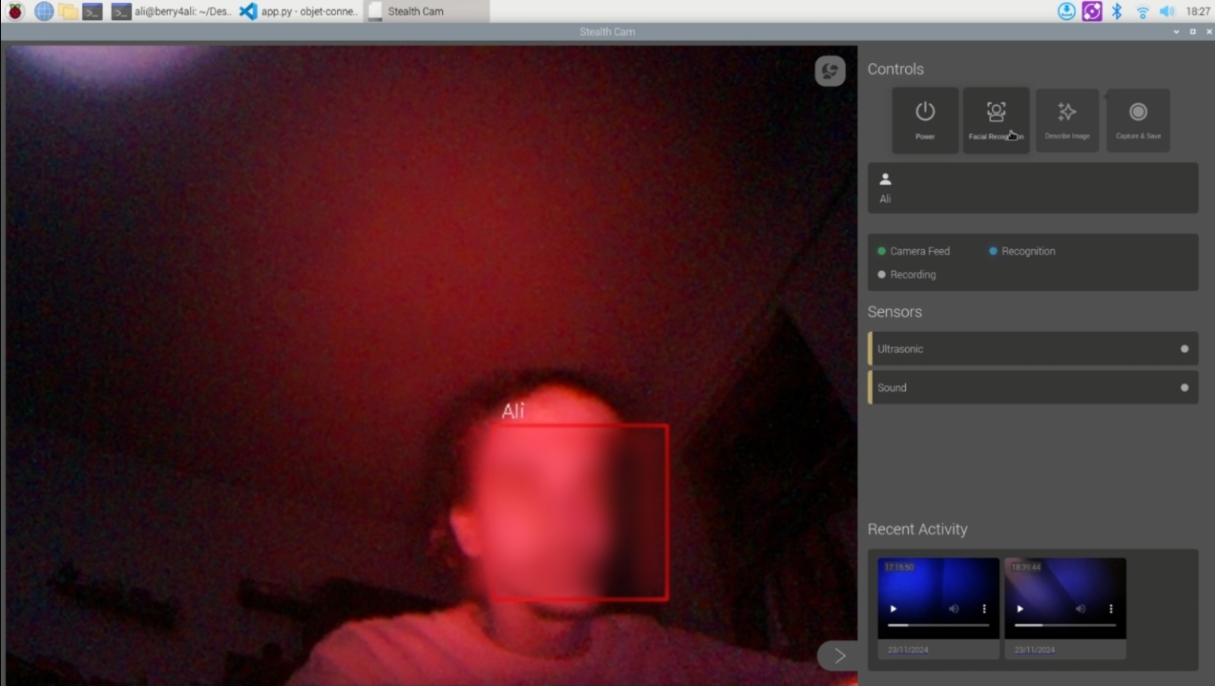
The StealthCam project was born out of a desire to explore the possibilities offered by the Internet of Things (IoT) by creating a smart home security system for our connected object course at Cégep de Rosemont. The idea was to merge hardware (sensors and cameras) with modern software technologies such as facial recognition and artificial intelligence. This project allowed me to learn how to manage communication between sensors, a Python backend processing real-time data streams, and a fluid desktop user interface.
Contribution
On this project, I was responsible for developing the entire architecture, from the backend to the user interface. I set up the Flask server to orchestrate the various services, including managing an SQLite database for activity history. I integrated facial recognition with the face_recognition library and the OpenAI API to generate intelligent textual descriptions of the captured images. On the client side, I developed the desktop application with Electron, using GSAP to create a modern and dynamic interface. I also took care of the configuration of the ultrasonic and sound sensors.
Project Gallery
Visual Overview
Approach
I adopted a modular approach to separate the hardware detection logic from the application layer. The backend functions as a service center where each sensor (motion, sound, light) is processed independently before being synthesized by the server. For the user experience, I chose Electron to provide a robust desktop application capable of communicating easily with the local file system and the Flask server. This structure allows for high system responsiveness, which is crucial for a real-time monitoring device.
Features
- Built-in facial recognition
- Motion detection Sound
- Automatic night mode
- AI image description
- Automatic video recording
- Electron desktop application
- Activity history
More Projects


